
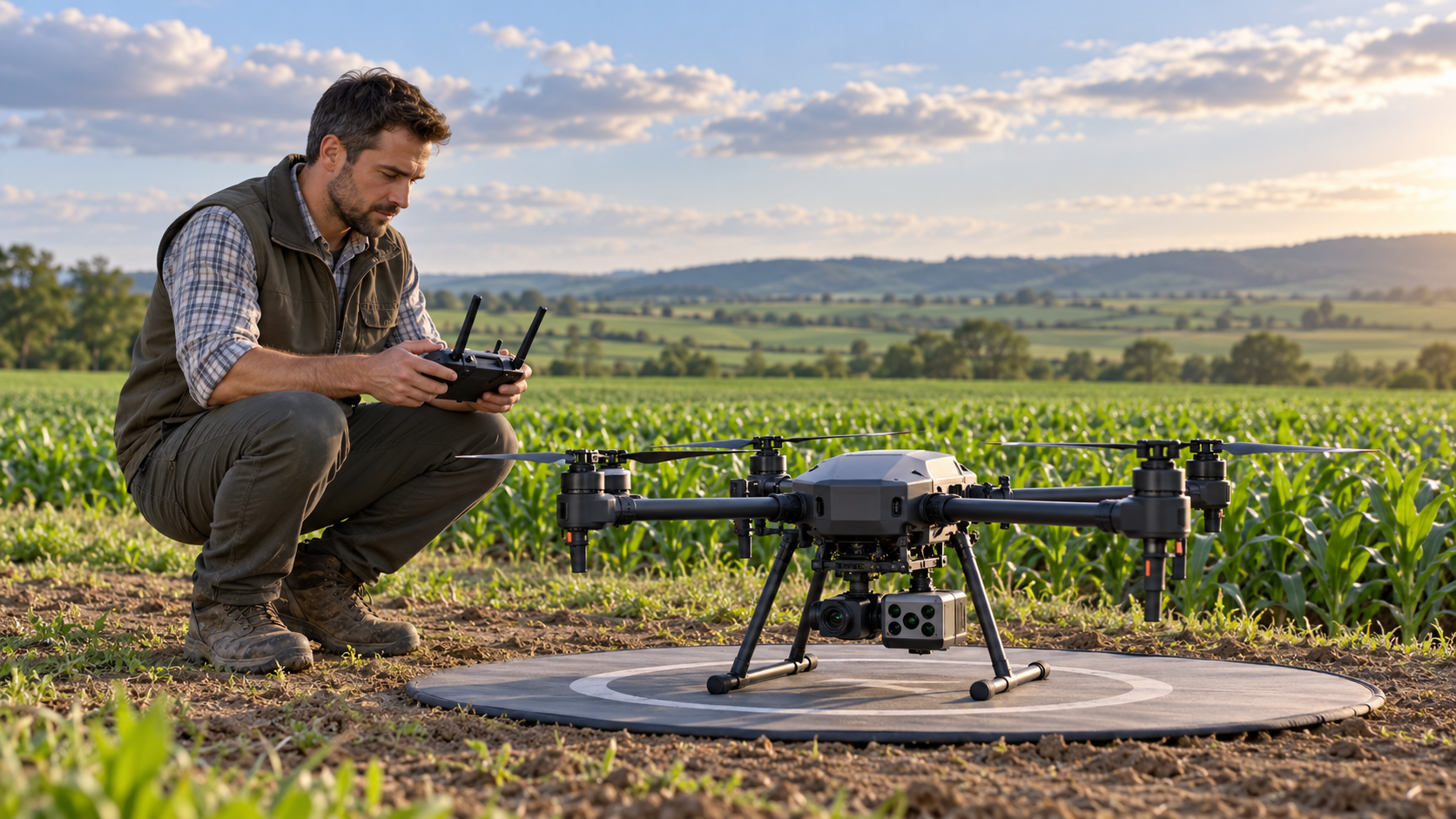
An RGB camera records visible red, green and blue imagery, useful for viewing rows, gaps and visible damage. A multispectral camera records selected wavelength bands, often including near-infrared, to support vegetation indices and other analytical products. Extra bands add measurement options, not automatic diagnosis.
RGB vs multispectral cameras: match the task
| Task | Starting option |
|---|---|
| Visible stand gaps or lodged areas | Suitable RGB imagery may be sufficient |
| True NDVI calculation | Requires appropriate red and near-infrared measurements |
| Comparing reflectance over time | Calibrated sensor and consistent processing |
| Identifying a nutrient or pest cause | Ground assessment alongside imagery |
Purdue’s plant-health mapping comparison illustrates different image products and the need for ground checking. An RGB “plant health” colour map is not necessarily NDVI.
Understand calibration work
Multispectral surveys may require reflectance panels, light-sensor records and camera-specific processing. MicaSense explains the role of this workflow in its radiometric calibration guidance. Check whether a contractor supplies calibrated reflectance, a relative index or only a rendered image.
Compare ownership costs
- Camera and compatible aircraft.
- Calibration accessories and storage.
- Software subscriptions and processing time.
- Training, repeat surveys and interpretation.
- Repairs and local technical support.
Trial both outputs on a representative crop. Ask whether the added measurement changes a decision that matters economically. A camera upgrade with no usable interpretation process can create more data without improving management.
For US, UK, Canada and Australia, confirm aircraft compatibility and permitted operations before purchase. Local crop stage, canopy density and sunlight affect whether surveys can be compared meaningfully.
Can RGB be converted to multispectral?
Software can create visible-band indices, but it cannot invent a reliable near-infrared measurement absent from the sensor. Check which bands the advertised output actually uses.
Read GSD explained and NDVI interpretation.
Leave a Reply